 Skip to Content

When Does a Construction Accident in Queens Involve New York Labor Law?
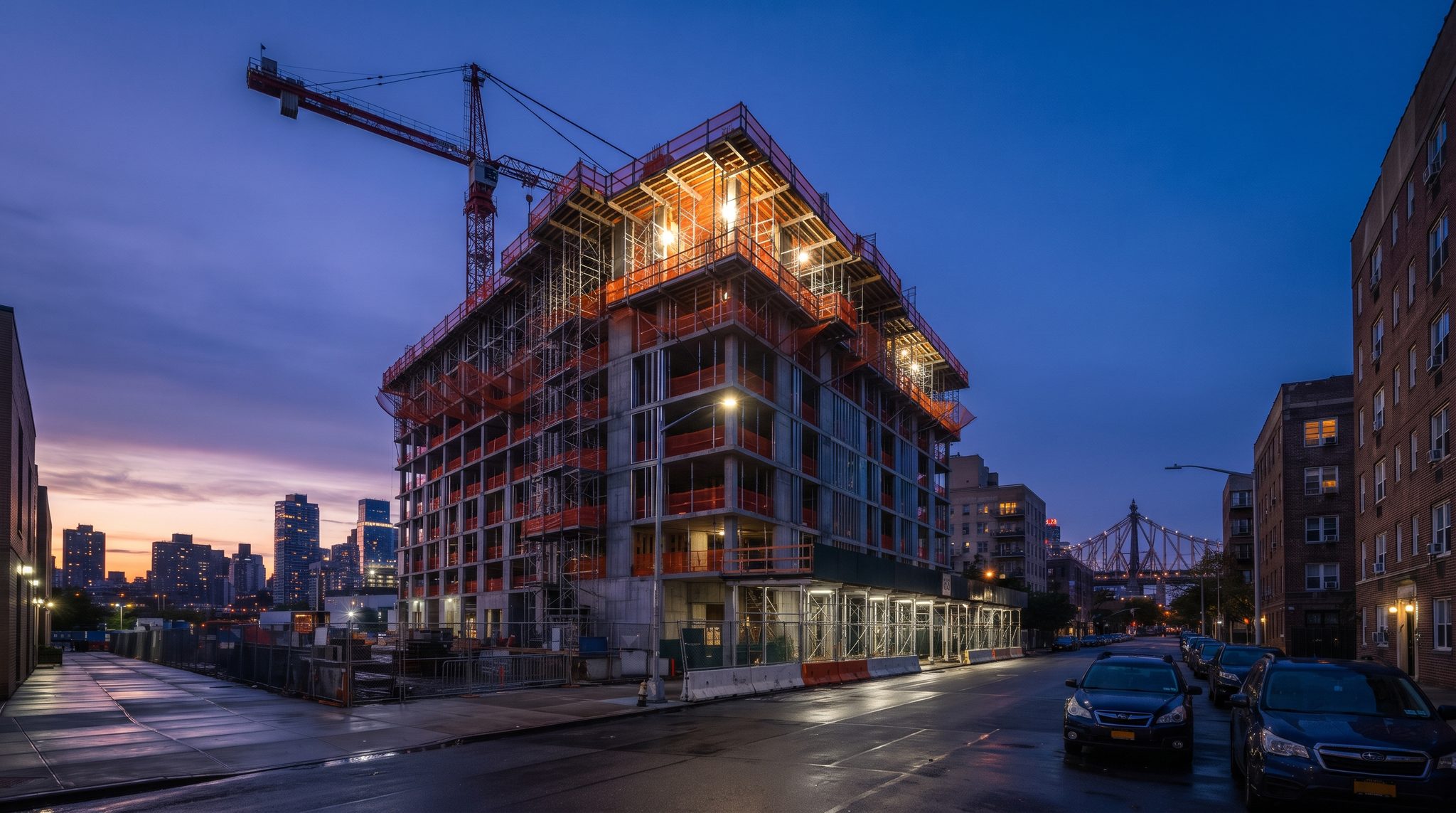
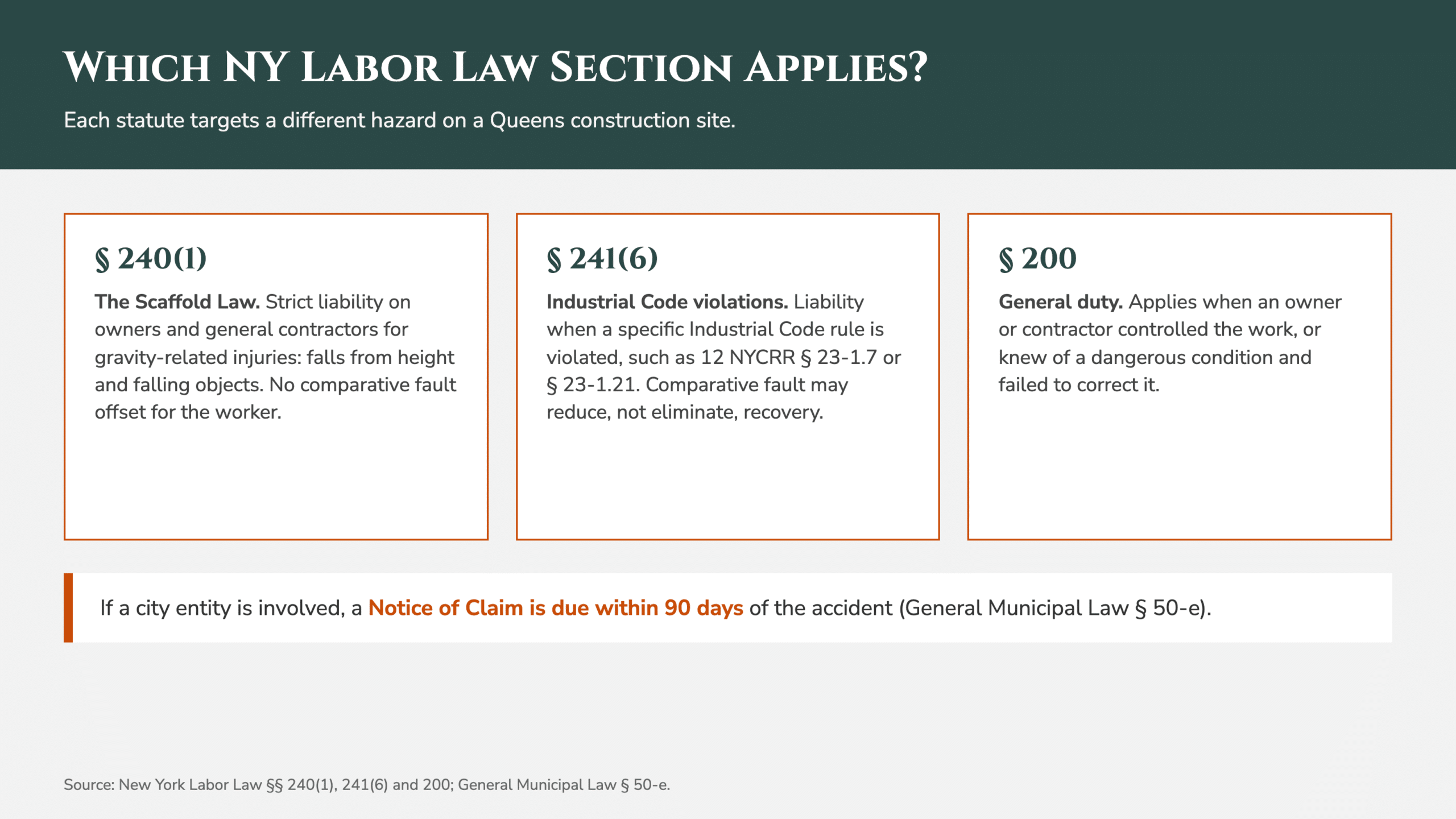
A construction accident in Queens triggers New York Labor Law when it occurs during the erection, demolition, repair, alteration, painting, cleaning, or pointing of a building or structure. A Queens construction accident lawyer can identify which of three statutes applies: Labor Law §240(1), which imposes strict liability on owners and general contractors for gravity-related injuries; Labor Law §241(6), which applies when a specific Industrial Code rule is violated; or Labor Law §200, the general duty provision covering unsafe conditions or inadequate supervision. A city entity’s involvement also triggers the 90-day Notice of Claim deadline under General Municipal Law §50-e. These protections apply regardless of whether a worker is union or non-union, and they cannot be waived by contract.
Which New York Labor Law Sections Apply to Queens Construction Injuries?
New York’s construction Labor Laws are among the strongest worker-protection statutes in the country. Each section targets a different type of hazard, and understanding which one applies shapes the entire legal strategy for your claim.
Labor Law §240(1): The Scaffold Law
New York Labor Law §240(1) imposes strict, absolute liability on property owners and general contractors for gravity-related accidents. This includes falls from heights and injuries caused by objects falling onto workers below. Critically, no comparative fault offset applies to the injured worker under this section: even if a worker made an error, the owner and contractor remain fully liable as long as adequate safety devices were absent.
Labor Law §241(6): Industrial Code Violations
Labor Law §241(6) attaches liability when a specific, concrete rule in the New York State Industrial Code is violated. Common examples include 12 NYCRR §23-1.7 on slipping and tripping hazards and §23-1.21 governing ladder requirements. Unlike §240(1), comparative fault may reduce a §241(6) recovery, but it does not eliminate it.
Labor Law §200: The General Duty Clause
Labor Law §200 is the statutory codification of a general duty to maintain a safe worksite. It applies when an owner or contractor controlled or supervised the method of work, or had actual or constructive notice of a dangerous condition. This section is particularly relevant in cases where a hazardous condition existed on site that the property owner knew about but failed to correct.
What Types of Queens Job-Site Accidents Qualify Under Labor Law §240(1)?
Section 240(1) covers a wider range of accidents than many workers realize. If any elevation differential was involved in your injury, the Scaffold Law may apply.
Accident types that commonly qualify include:
- Falls from scaffolding, ladders, rooftops, and elevated platforms: These are the most frequently litigated §240(1) claims in New York courts.
- Injuries from falling objects: Unsecured tools, building materials, or debris dropped from height trigger §240(1) when proper hoisting or securing devices were not provided.
- Structural collapses: Improperly braced structures that give way during demolition or alteration work fall within the statute’s scope.
- Electrocution and forklift incidents tied to elevation differentials: Courts have extended §240(1) coverage to certain electrocution and equipment cases where an elevation-related risk was a proximate cause.
- Strict liability standard: The injured worker does not need to prove the owner or contractor was careless. The worker must show only that an adequate safety device was absent or defective.
For a deeper look at how these cases are built, see our page on New York Labor Law §240(1) scaffold law cases.
Who Is Covered, and Who Is NOT, Under New York’s Construction Labor Laws?
Coverage under §240(1) and §241(6) is broad, but not universal. Knowing whether you qualify is the first question any Queens personal injury lawyer will ask.
Who is covered:
- Construction workers, painters, demolition laborers, tradespeople, and renovation workers performing covered work on a building or structure.
- Workers regardless of immigration status: New York courts have consistently held that Labor Law protections apply to all workers performing covered work, and documentation status does not affect eligibility.
- Workers regardless of union affiliation: union and non-union workers receive equal protection under the statutes.
Who may not be covered:
- Homeowner exemption: A homeowner who contracts work on a one- or two-family dwelling and does not direct or control the work may qualify for the statutory homeowner exemption under §240(1) and §241(6). This narrows your available defendants in residential cases.
- Routine maintenance workers: Courts have held that purely routine maintenance tasks performed without any elevation risk may fall outside the categories of work the statutes protect. Whether a task qualifies as “maintenance” versus “repair” is frequently litigated.
Where Are Queens Construction Accident Hotspots and Why Does Location Matter?
Queens has extensive active construction across the borough, and certain corridors concentrate job-site risk.
- Long Island City and Astoria: Large-scale residential and mixed-use development along the Queens waterfront has driven a sustained increase in active job sites, with ongoing projects along 21st Street and Vernon Boulevard placing workers at daily elevation and falling-object risk.
- Jamaica and South Jamaica: Infrastructure and transit-adjacent redevelopment near AirTrain and LIRR stations generates consistent scaffold, crane, and roadway-work exposure.
- Flushing downtown: High-rise residential and commercial construction along Main Street and Northern Boulevard places both pedestrians and construction workers at overlapping risk.
OSHA Region 2 data publishes construction enforcement and fatality data covering New York City job sites.
Location matters for more than just statistical context. If the property is city-owned or involves a city contractor, a Notice of Claim under General Municipal Law §50-e must be filed within 90 days of the accident. Missing that deadline can permanently bar recovery against the City, regardless of how strong the underlying Labor Law case is. Learn more about what is a Notice of Claim and how does the 90-day deadline work.
How Does Being a Former NYC Defense Attorney Help Queens Construction Workers?
Brian O’Connor served as a Former Assistant Corporation Counsel for the City of New York, the office responsible for defending the City, its agencies, and city contractors in personal injury litigation. That experience gives him a direct line of sight into how the City builds its defense before a plaintiff’s attorney even files a claim.
The City’s defense team commonly argues:
- That the work performed was “routine maintenance” and therefore outside §240(1) or §241(6) coverage.
- That the plaintiff was not a covered “worker” under the statute.
- That the specific Industrial Code section cited is not “concrete enough” to support §241(6) liability.
Brian knows these arguments because he once made them. That insider knowledge shapes how O’Connor Injury Law documents and positions Queens construction cases from day one, before the City’s defense team begins building its file. The 90-day Notice of Claim clock starts running the day of the accident; even a strong Labor Law case can be lost entirely if that deadline is missed.
See our full overview of NYC construction accident representation to understand how these cases are handled from intake through resolution.
What Steps Should Queens Construction Accident Victims Take Immediately?
The actions you take in the hours and days after a job-site injury directly affect the strength of your Labor Law claim. Follow these steps:
- Seek emergency medical care: Document all injuries at the treating facility. A medical record created the same day is foundational evidence.
- Preserve the site: Photographs of the scaffold, ladder, floor surface, or falling-object zone taken immediately after the accident are among the most powerful evidence available in a Labor Law case.
- Identify all parties: Note the name of the general contractor, property owner, and any subcontractors working on site. All may be liable under §240(1) or §241(6).
- Do not give a recorded statement: Do not speak with any insurance adjuster before consulting an attorney. Recorded statements are routinely used to undermine otherwise strong claims.
- Contact a Queens construction accident lawyer promptly: The 90-day Notice of Claim deadline under General Municipal Law §50-e is an absolute cutoff when any city entity owns or controls the property. There is no extension for workers who were unaware of the rule.
Contact O’Connor Injury Law After a Queens Construction Accident
If you or a family member was hurt on a Queens job site, the statutes that protect you are strong, but the deadlines are unforgiving. O’Connor Injury Law brings a rare perspective to these cases: Brian O’Connor spent years on the other side of this litigation as a Former Assistant Corporation Counsel for the City of New York, and he now puts that knowledge to work exclusively for injured workers and their families across Queens and the five boroughs. Do not wait to find out whether the 90-day clock is already running. Contact O’Connor Injury Law today for a free consultation.