 Skip to Content

Where Are the Most Dangerous Intersections in Manhattan for Drivers and Pedestrians?
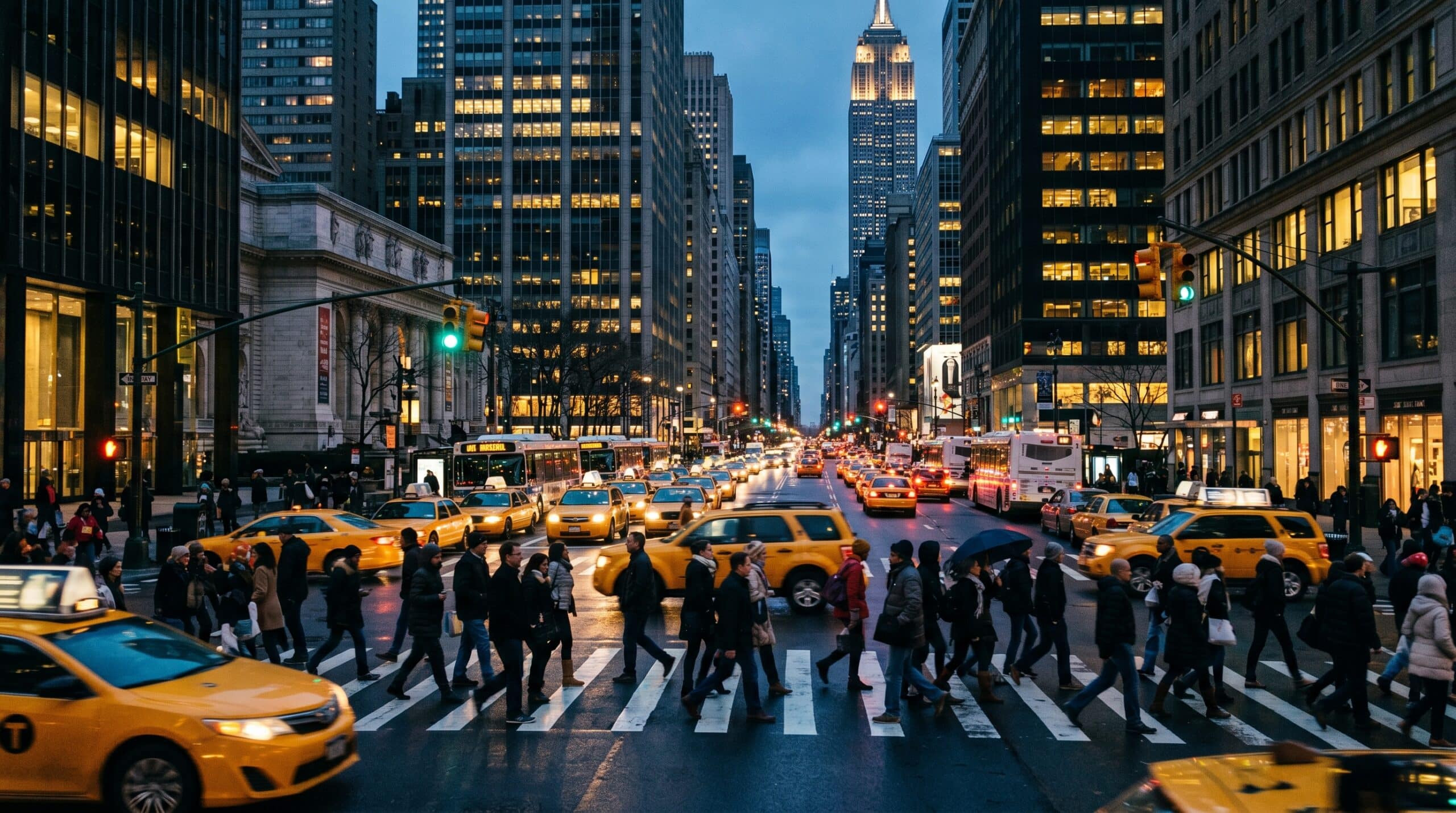
Where Are the Most Dangerous Intersections in Manhattan for Drivers and Pedestrians?
Some of Manhattan’s most dangerous intersections see dozens of crashes every year, and if you’ve been hurt in one of them, talking to a Manhattan car accident lawyer is one of the most important steps you can take. According to NYC Vision Zero crash data, Manhattan consistently ranks among the borough’s most crash-heavy areas, with pedestrians, cyclists, and drivers all sharing roads that were never built for modern traffic volumes.
This guide walks through the corridors where collisions happen most often, explains the New York legal rules that govern your claim, and shows you how O’Connor Injury Law helps injured people across all five boroughs move forward after a serious crash.
Why Manhattan Intersections Are Uniquely Dangerous
A Grid Built Before Mass Motorization
Manhattan’s street grid was laid out in 1811, long before automobiles existed. Today that same grid funnels millions of daily trips through a tight network of avenues and cross streets where delivery trucks, rideshare vehicles, city buses, cyclists, and pedestrians all compete for the same narrow space. The result is a collision environment that’s fundamentally different from suburban roads, or even other big cities.
High Pedestrian and Cyclist Exposure
Because so many New Yorkers get around on foot or by bicycle, a driver’s mistake in Manhattan often does more damage than it would in places where everyone is inside a vehicle. NHTSA traffic safety facts consistently show that speeding, distraction, and failure to yield are the leading behavioral causes of fatal urban crashes, and all three are common in dense Midtown and Lower Manhattan corridors. When a vehicle strikes a pedestrian or cyclist, the injuries tend to be serious, sometimes serious enough to meet New York’s legal threshold for a third-party lawsuit.
City Infrastructure and Traffic Signal Timing
Short block lengths, frequent signal changes, and aggressive turning movements create conflict points at nearly every intersection. Drivers turning across pedestrian crosswalks, cyclists rolling through stale greens, and rideshare vehicles stopping mid-lane to pick up passengers all add to the borough’s stubbornly high crash numbers. Knowing where these conflicts cluster can help you recognize whether you were hurt at a known hazard location, and that can be important evidence in a personal-injury case.
Where Most Manhattan Crashes Happen: Times Square, Queensboro, Midtown, Lower Manhattan
Times Square Corridor
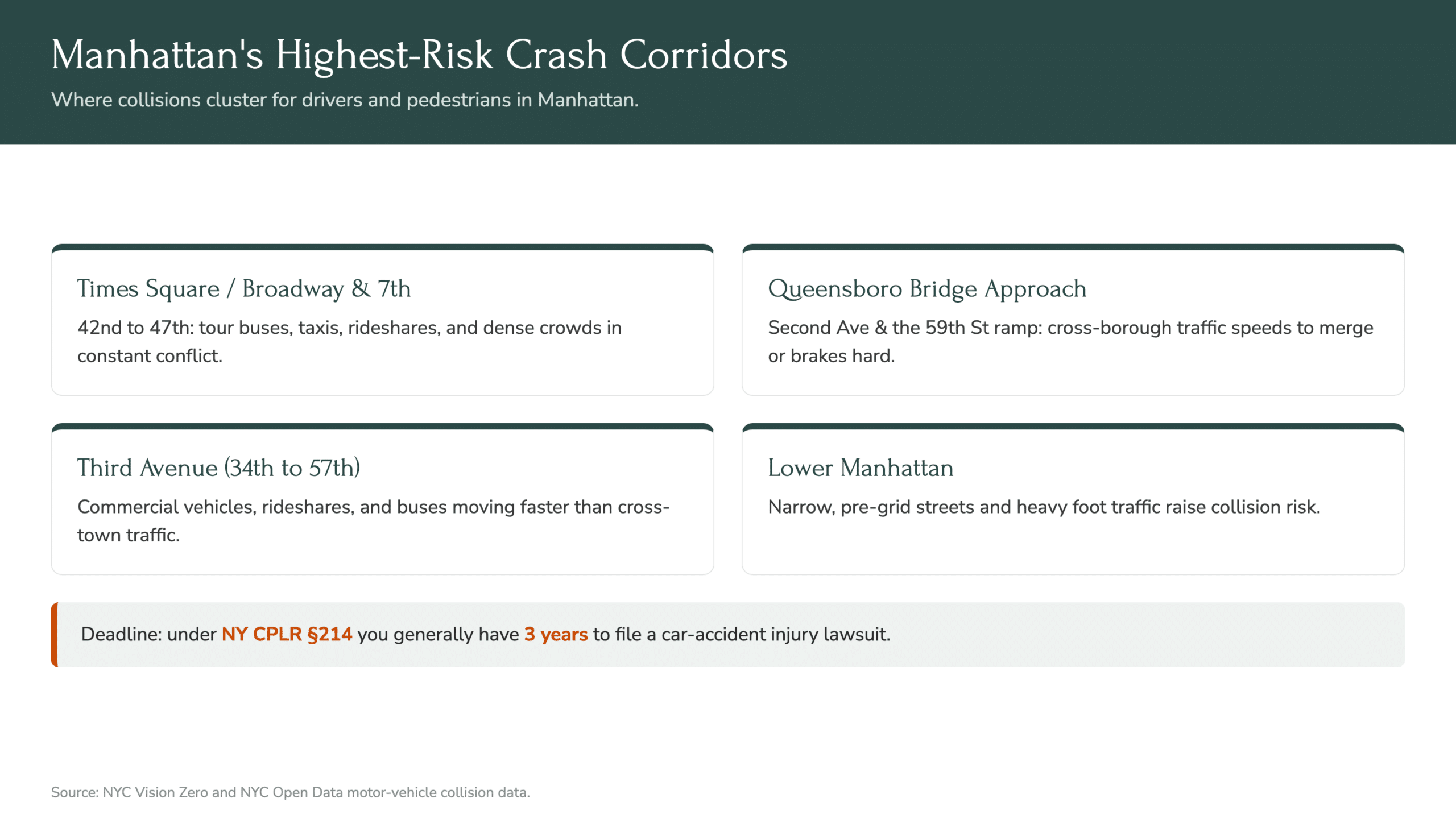
The stretch of Broadway and Seventh Avenue between 42nd and 47th Streets is one of the highest-conflict zones in the city. Tour buses, taxis, rideshare pickups, and delivery vehicles all converge with tens of thousands of pedestrians who cross mid-block or ignore signals. The pedestrian plazas added in recent years have cut down on some vehicle-on-pedestrian conflicts, but the surrounding side streets absorb the diverted traffic and create new pinch points. If you were injured near Times Square, our team will look at whether a driver’s failure to yield, illegal turn, or distracted driving caused your crash.
Queensboro Bridge Approach on the East Side
The Queensboro Bridge approach along Second Avenue and the 59th Street ramp draws heavy crossboro traffic that speeds up to merge or brakes hard when bridge traffic backs up. That shift from local Manhattan streets to bridge ramp speed creates a high-risk zone for rear-end collisions and sideswipes. Cyclists using the dedicated bridge lane have to cross vehicle lanes at the approach, which adds another layer of exposure. NYC DOT crash data portal tracks intersection-level collision histories, and our team reviews them when evaluating cases in this corridor.
Midtown Third Avenue
Third Avenue from roughly 34th to 57th Street sees a dense mix of commercial vehicles, rideshares, and commuter buses moving faster than the cross-town streets. Double-parking by delivery trucks pushes drivers into the travel lane without warning, and cyclists are often caught between moving traffic and opening car doors. This corridor shows up again and again in borough crash analyses as a place where injury collisions are disproportionately concentrated relative to traffic volume.
Canal Street and Broadway in Lower Manhattan
Canal Street at Broadway is a critical convergence point where traffic from the Holland Tunnel, the Manhattan Bridge, and local Lower Manhattan streets all meet. The volume of commercial trucks, tourist buses, and through-traffic creates frequent aggressive-merging situations. Pedestrians crossing Canal Street face long crossing distances and drivers who are focused on finding gaps in fast arterial traffic rather than watching for people in the crosswalk. Crashes here often involve multiple vehicles, or a vehicle striking someone on foot.
What to Do After a Manhattan Car Accident
The steps you take in the hours and days after a collision directly affect your ability to recover compensation. New York’s no-fault system means your own insurer pays your initial medical bills regardless of fault, but preserving evidence and meeting filing deadlines still matters enormously for any additional claim you may have. Our NYC car accident lawyer team handles these details so you can focus on getting better.
- Call 911 and stay at the scene. Ask for police and emergency medical services even if your injuries feel minor. A police report creates an official record of the crash location, the parties involved, and any violations the officer noticed.
- Seek medical attention right away. Some serious injuries, like concussions and soft-tissue damage, don’t produce obvious symptoms at first. A same-day medical evaluation documents the connection between the crash and your condition.
- Gather evidence at the scene if you’re able to. Photograph the vehicles, road conditions, traffic signals, skid marks, and any visible injuries. Collect the names and contact information of every driver and witness.
- Report the crash to your insurer promptly. New York no-fault rules require you to notify your insurer quickly. Delays can put your access to first-party medical and lost-wage benefits at risk.
- Don’t give a recorded statement to the other driver’s insurer without legal advice. Adjusters are trained to ask questions in ways that can limit your recovery. Talking to an attorney first protects your interests.
- Keep a recovery journal. Write down your symptoms, medical appointments, missed work days, and how your injuries affect your daily life. That day-to-day record becomes valuable evidence of your pain and suffering.
- Contact O’Connor Injury Law. Our team will review your case at no charge, tell you whether your injuries meet New York’s serious injury threshold, and handle all the back-and-forth with insurers and opposing counsel.
New York’s No-Fault Rules and the Serious Injury Threshold
How No-Fault Coverage Works
New York is a no-fault insurance state, which means that after a car accident, your own auto insurer pays your initial medical expenses and a portion of lost wages up to statutory limits, no matter who caused the crash. The idea is to get injured people medical care quickly without waiting for fault to be sorted out. That said, no-fault benefits don’t compensate you for pain and suffering, full lost earnings, or other non-economic losses.
The Serious Injury Threshold
To step outside the no-fault system and bring a lawsuit against the at-fault driver for pain and suffering damages, your injuries have to meet the “serious injury” threshold defined in NY Insurance Law §5102 (serious injury threshold). In plain terms, that statute requires your injury to fall into one of several categories: a bone fracture, significant disfigurement, permanent limitation of a body organ or member, significant limitation of use of a body function, or a medically determined injury that keeps you from performing substantially all of your usual daily activities for at least 90 of the 180 days after the accident. Meeting this threshold is often the central legal question in a Manhattan car accident case, and our team works with your treating physicians to document your condition precisely.
The Statute of Limitations
Even if your injuries clearly meet the threshold, you still have to file your lawsuit within the time period set by NY CPLR §214 (statute of limitations), which gives most personal-injury plaintiffs three years from the date of the accident to start a civil action. In plain terms, miss that deadline and you generally lose your right to sue, no matter how strong your case is. Wrongful-death claims carry a shorter window, so contacting an attorney as soon as possible is always the safer move.
How a Manhattan Car Accident Lawyer Builds Your Case
Investigating the Crash Scene
A strong car accident case starts with a thorough investigation, before the evidence disappears. Our team secures surveillance footage from nearby businesses and traffic cameras, obtains the police accident report, and reviews NY DMV statistical summaries and intersection crash histories to establish whether a known hazard played a role in your collision. If a commercial vehicle was involved, we subpoena driver logs, dispatch records, and vehicle maintenance files.
Establishing Liability and Damages
New York follows a pure comparative negligence rule, which means your recovery is reduced by your percentage of fault, but you’re not barred from collecting even if you were partly responsible. Our attorneys work with accident reconstructionists and medical experts to show the other party’s negligence and to document the full scope of your damages, including future medical costs, lost earning capacity, and non-economic harm. We also coordinate with your health insurer and no-fault carrier so liens are handled properly and you keep as much of any settlement or verdict as possible.
Negotiating with Insurers
Insurance companies handling Manhattan crash claims are experienced at minimizing payouts. They may dispute whether your injuries meet the serious injury threshold, argue that a pre-existing condition caused your symptoms, or float an early lowball offer before you understand the full extent of your medical needs. Having a Manhattan personal injury lawyer at the table changes the dynamic. We answer coverage disputes with medical documentation and legal arguments, and we’re fully prepared to litigate if a fair settlement can’t be reached.
Contact O’Connor Injury Law for Manhattan Car Accident Help
If you or someone you love was injured in a Manhattan car crash, you don’t have to figure out New York’s no-fault rules, serious injury thresholds, and litigation deadlines on your own. O’Connor Injury Law represents injured people across all five boroughs, with a team that knows the specific roads, intersections, and local legal landscape that shape every Manhattan case.
Our consultations are free and confidential. If we take your case, we work on a contingency fee basis, which means you pay nothing unless we recover for you. Reach our Manhattan office at +1-866-938-5092, or visit our NYC car accident lawyer page to learn more about how we handle vehicle collision claims. You can also explore our Staten Island no-fault insurance lawyer resource if you have questions about no-fault benefits in any borough. O’Connor Injury Law is ready to help you take the next step.
FAQs