 Skip to Content

Who Can File a Wrongful Death Claim in Staten Island, New York?

Who Can File a Wrongful Death Claim in Staten Island, New York?
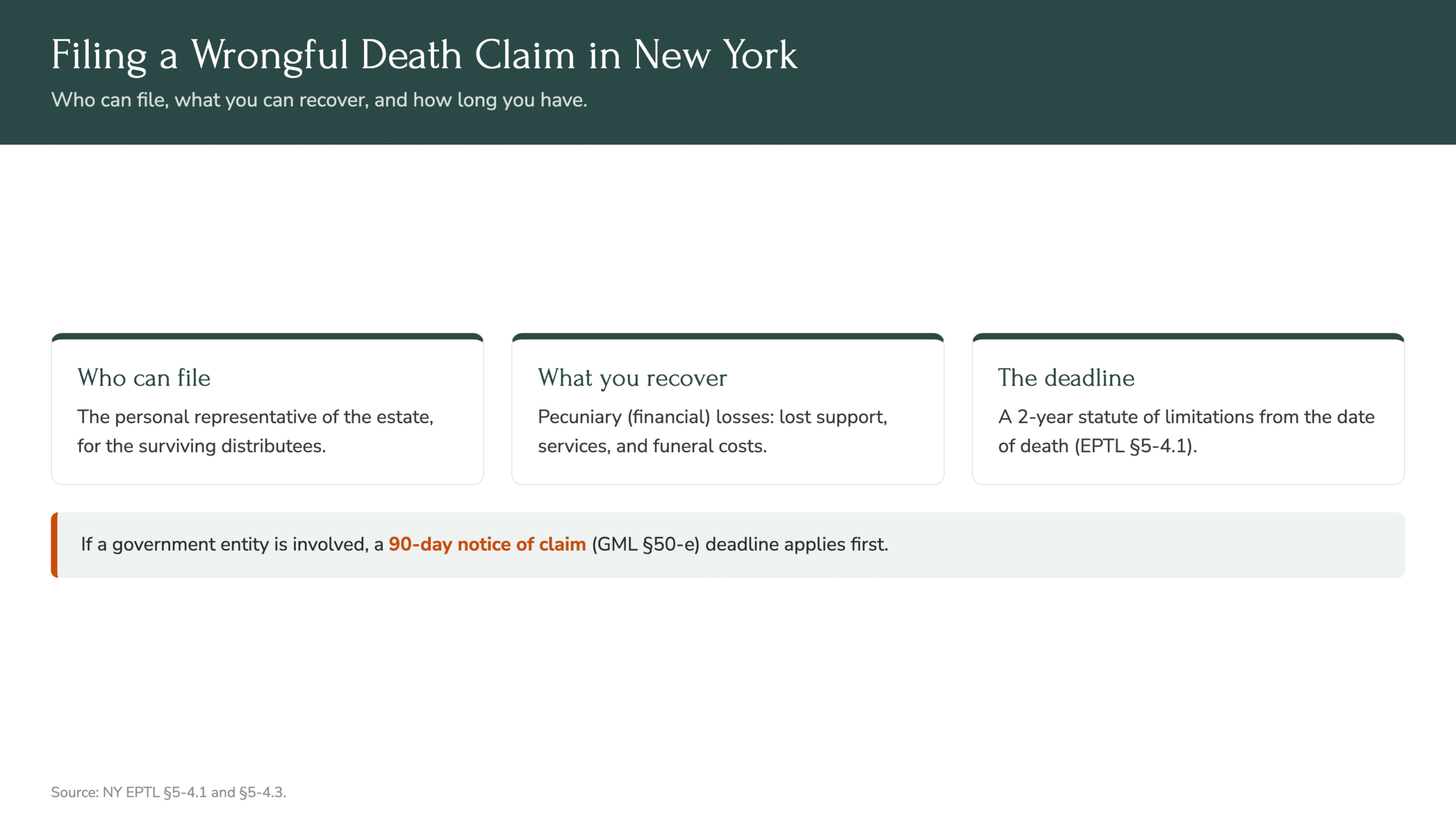
Under NY EPTL §5-4.1 (right to sue for wrongful death), only the personal representative of the deceased’s estate can file a wrongful death claim in Staten Island, and a Staten Island wrongful death lawyer can guide the family through the strict two-year deadline.
Losing a family member because of someone else’s negligence is one of the hardest experiences a family can face. New York law gives surviving family members a legal path to seek compensation, but the rules about who can sue, what damages are recoverable, and how long you have to act are specific and unforgiving. Understanding these rules early can protect your family’s rights.
What Qualifies as Wrongful Death Under New York Law
The Basic Legal Definition
A wrongful death claim comes up when a person dies as a result of the wrongful act, neglect, or default of another party. Under NY EPTL §5-4.1 (right to sue for wrongful death), the claim has to be one that the deceased person could have pursued personally had they survived. In plain terms, if the victim could have sued for their injuries while alive, their estate can sue for their death.
Wrongful death isn’t limited to car accidents. It can come from medical malpractice, construction accidents, defective products, premises liability incidents, and more. What matters legally is that another party’s negligence or intentional misconduct caused the fatal outcome.
How It Differs From a Survival Claim
New York recognizes two distinct claims that often come up together: a wrongful death claim and a survival claim. The wrongful death claim compensates the family for their own financial losses. The survival claim, on the other hand, compensates the estate for the pain, suffering, and losses the deceased person went through between the time of injury and death. Both claims can be brought in the same lawsuit, and an experienced legal team can help you pursue both.
Who Has the Legal Right to File a Staten Island Wrongful Death Claim
The Personal Representative Requirement
New York doesn’t allow surviving family members to file a wrongful death lawsuit directly in their own names. NY EPTL §5-4.1 (right to sue for wrongful death) requires that the action be brought by the personal representative of the deceased’s estate. That person is usually named in the deceased’s will, or appointed by the Surrogate’s Court if there’s no will.
This requirement can catch families off guard when they assume they can sue on their own behalf. The personal representative acts on behalf of the estate and, ultimately, on behalf of the surviving distributees, the people entitled to share in the recovery.
Who Receives the Recovery
Once a recovery comes through, NY EPTL §5-4.4 (distribution of recovery) governs how the proceeds are distributed. The money goes to the deceased’s distributees, which generally means a surviving spouse, children, or parents, depending on the family structure. The distribution follows a specific priority order set by statute, and the court may need to approve the allocation in certain situations.
Steps to File a Wrongful Death Claim in New York
Filing a wrongful death claim in New York involves a series of procedural steps that have to be completed in the right order and within strict deadlines. Miss any one of these steps and you can jeopardize your family’s ability to recover. Here’s a general overview of the process.
- Secure the appointment of a personal representative: Before any lawsuit can be filed, the estate needs a personal representative. If the deceased left a will, the executor named in the will typically takes this role. If not, the Surrogate’s Court for Richmond County can appoint an administrator.
- Preserve evidence immediately: Gather police reports, medical records, photographs, witness contact information, and any surveillance footage relevant to the incident. Evidence can disappear quickly, especially after traffic crashes on the Staten Island Expressway or Hylan Boulevard corridor.
- Identify all potentially liable parties: Depending on the circumstances, liability may fall on individual drivers, property owners, employers, product manufacturers, or government entities. A thorough investigation is essential before you narrow the scope of your claim.
- File a notice of claim if a government entity is involved: If the death involved a city agency, a municipal vehicle, or a defective public roadway near the Verrazzano-Narrows Bridge corridor or Bayonne Bridge approaches, you have to file a notice of claim under NY General Municipal Law §50-e (notice of claim) within 90 days of the incident. This is a hard deadline that courts rarely extend.
- Consult a wrongful death attorney: A Staten Island PI lawyer can evaluate your claim, identify all available insurance coverage, and advise on the realistic value of your case before any litigation begins.
- File the lawsuit in the appropriate court: The personal representative files the wrongful death complaint in New York Supreme Court, Richmond County for Staten Island cases. The complaint has to be served on each defendant according to the Civil Practice Law and Rules.
- Negotiate or litigate to resolution: Most wrongful death cases resolve through settlement negotiations. If a fair settlement can’t be reached, the case goes to trial. Our team prepares every case as if it will go to trial, which strengthens your negotiating position throughout.
What Damages Can a Staten Island Wrongful Death Lawyer Recover?
Categories of Recoverable Losses
New York’s wrongful death statute limits the categories of damages a family can recover, and understanding these categories helps set realistic expectations. Under NY EPTL §5-4.3 (wrongful death damages), recoverable damages are primarily pecuniary in nature. That means they focus on the measurable financial impact of the death on surviving family members rather than on grief or emotional suffering.
Recoverable items typically include lost financial support the deceased would have provided, the value of household services, medical and funeral expenses related to the death, and, in some cases, the value of parental guidance and nurturing for surviving minor children.
Pain and Suffering Limitations
One part of New York wrongful death law that surprises many families is that the grief and emotional suffering of the survivors aren’t recoverable under the wrongful death statute itself. That said, if the deceased experienced conscious pain and suffering before death, that element is recoverable through a separate survival claim. Our team carefully evaluates both avenues to maximize the total recovery available to your family.
Pecuniary Loss: How New York Calculates Wrongful Death Damages
What Pecuniary Loss Means in Practice
Pecuniary loss is the cornerstone of a New York wrongful death recovery. Courts read it broadly to include not just lost wages and benefits, but also the monetary value of services the deceased provided to the household. For a parent, that can include childcare, tutoring, transportation, and emotional guidance that can be assigned an economic value. Expert witnesses like economists and life-care planners are often brought in to quantify these losses accurately.
The calculation accounts for the deceased’s age, health, occupation, earning history, and life expectancy at the time of death. For younger victims, the projected loss of future earnings over a working lifetime can be substantial. CDC WISQARS injury data provides context on the leading causes and economic burden of injury-related deaths that attorneys and economists use as a reference framework.
Distributing Damages Among Family Members
After a recovery comes through, the court allocates the wrongful death proceeds among the distributees in proportion to each person’s demonstrated pecuniary loss. A surviving spouse who relied heavily on the deceased’s income may receive a larger share than an adult child who was financially independent. NY EPTL §5-4.4 (distribution of recovery) governs this allocation and requires court approval for any distribution to minor children.
The Two-Year Statute of Limitations and Why Early Action Matters
The Core Deadline
New York puts a two-year statute of limitations on wrongful death claims. Under NY CPLR §214 (statute of limitations), the two-year clock generally starts running from the date of the deceased’s death, not the date of the underlying accident. If your family misses this deadline, the court will almost certainly dismiss the case, no matter how strong the underlying facts are.
Two years may feel like a long time, but the practical demands of a wrongful death case mean you really need to act much sooner. Witnesses’ memories fade, surveillance footage gets overwritten, and key documents can be lost or destroyed. Starting the investigation within weeks of the death, rather than months or years later, preserves the best evidence.
Special Deadlines for Government Claims
If any part of your claim involves a government entity, like the City of New York or the New York State Department of Transportation, you face an additional and much shorter deadline. A notice of claim under NY General Municipal Law §50-e (notice of claim) has to be filed within 90 days of the death. This notice is a prerequisite to suing a municipal entity. Incidents near state-maintained corridors like the Bayonne Bridge approaches or the Staten Island Expressway may involve government defendants, which makes early legal consultation critical.
Common Causes of Staten Island Wrongful Death Claims
Traffic Corridors and Vehicle Accidents
Staten Island’s geography creates several high-risk traffic corridors that show up again and again in wrongful death investigations. The Staten Island Expressway (I-278) carries heavy commercial and commuter traffic between the Verrazzano-Narrows Bridge and the Goethals Bridge, which means significant crash exposure. Hylan Boulevard, one of the island’s longest surface roads, sees frequent pedestrian and cyclist conflicts. The Bayonne Bridge approaches involve trucks and commuters merging at high speeds. When fatal crashes happen in these locations, figuring out liability often requires analysis of road design, signage, driver behavior, and vehicle condition.
Other Frequent Causes
Beyond vehicle crashes, wrongful death claims on Staten Island commonly come from construction site accidents, medical malpractice, and falls on dangerous property. The Staten Island catastrophic injury lawyer page on our site covers many of these categories in more detail. Construction incidents often trigger analysis under New York’s labor laws, while premises liability cases involve the standard of care owed by property owners to people lawfully on their land.
Contact O’Connor Injury Law for Staten Island Wrongful Death Help
If you’ve lost a family member because of someone else’s negligence on Staten Island, O’Connor Injury Law is ready to help you understand your rights and take action before critical deadlines pass. Our team handles wrongful death claims across all five boroughs, and we know the roads, courts, and rules specific to Staten Island.
We’d encourage you to review our NYC wrongful death book for a plain-English overview of how New York wrongful death law works, and to contact our Staten Island wrongful death lawyer team for a free, confidential consultation. Call our Staten Island office at +1-866-927-3809 to speak with someone today. There’s no fee unless we recover for you.
FAQs