 Skip to Content

Why Does Brooklyn Lead NYC in Construction Worker Injuries?
Why Does Brooklyn Lead NYC in Construction Worker Injuries?
Brooklyn has one of the highest concentrations of active construction sites in New York City, and that density drives serious worker injuries every year. If you’ve been hurt on a job site, talking to a Brooklyn construction accident lawyer as soon as possible can protect rights you may not even know you have. According to BLS construction fatalities, construction accounts for roughly one in five worker fatalities nationwide, a number that shows just how dangerous the trade still is, even with modern safety regulations.
New York’s legal landscape gives injured construction workers powerful tools that workers in most other states simply don’t have. Understanding those tools, and knowing when to use them, is the first step toward a fair recovery after a job-site injury in Brooklyn.
Why Brooklyn Sees More Construction Injuries Than Most NYC Boroughs
A Dense Urban Build Environment
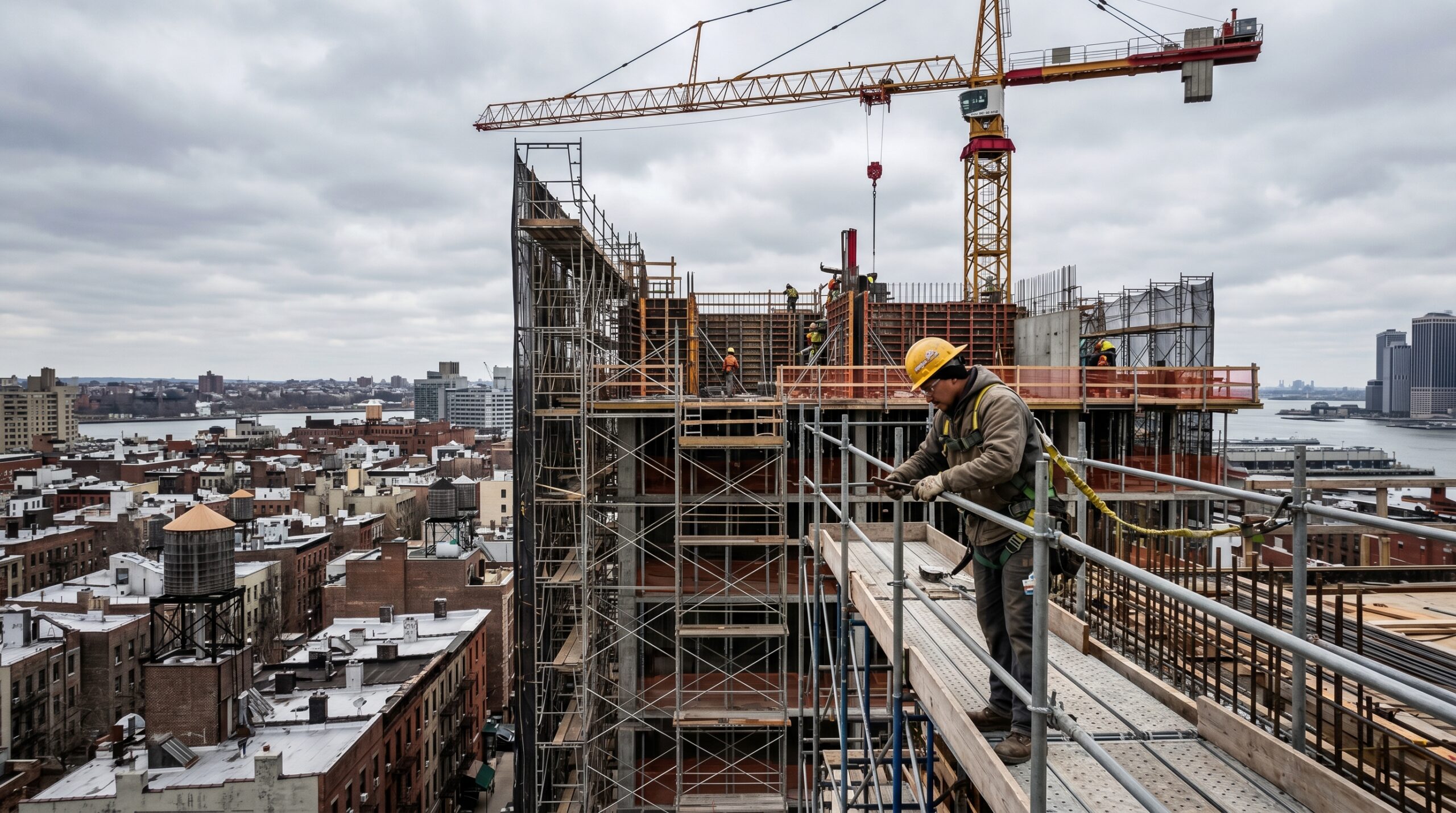
Brooklyn’s mix of aging industrial infrastructure and rapid new development creates an unusually hazardous environment for construction workers. Older buildings need gut renovations that expose workers to unstable structures, legacy materials, and confined spaces, while new high-rise projects bring fall hazards at significant heights. The NYC DOB construction safety program monitors thousands of active permits across the borough at any given time, and the sheer number of projects running at once strains inspection resources.
Overcrowded job sites, tight urban lots, and proximity to active streets pile on layers of risk that simply don’t exist in less dense construction settings. A scaffolding collapse or a falling tool that might cause minor harm on an open suburban site can do far more damage when it happens on a busy Brooklyn block.
Workforce and Oversight Pressures
Brooklyn’s construction workforce is large, diverse, and often hired through multi-tiered subcontracting arrangements. Those arrangements can blur who’s actually accountable for safety compliance. When a general contractor hands safety duties to a sub, and that sub hands them to another, the worker at the bottom of the chain is usually the one who carries the physical risk of any gap in oversight. OSHA construction industry statistics consistently show that small subcontractors have higher injury rates than larger, directly supervised crews.
The Brooklyn Construction Boom and Its Hidden Costs
Rapid Development, Compressed Timelines
Brooklyn has seen sustained residential and commercial development over the past decade, driven by demand for housing and commercial space in neighborhoods that were once largely industrial. That pace brings financial pressure to finish projects fast, and compressed timelines are consistently tied to shortcuts in safety planning and equipment maintenance. When a contractor skips a required safety net or fails to provide adequate fall protection to hit a deadline, the worker on the scaffold pays the price.
Hidden Human Costs
The cost of a serious construction injury reaches far beyond the job site. Lost wages, long-term rehabilitation, and permanent disability hit not just the injured worker but an entire household. Many Brooklyn construction workers are the primary earners for their families, and a single serious injury can destabilize a family’s finances for years. Our NYC construction accident injury book explains in plain terms what financial recovery can look like and what steps to take from the moment of injury.
High-Risk Job Sites: Williamsburg, Downtown Brooklyn, and Sunset Park
Williamsburg and Greenpoint
Williamsburg and neighboring Greenpoint have seen a sustained wave of mixed-use and luxury residential construction, turning former industrial waterfront parcels into high-rise towers. These projects involve extensive below-grade excavation, multi-story steel erection, and facade work at significant heights, all of which come with elevated fall and struck-by risks. Tight lot lines force workers to operate close to crane swing radii and material hoisting paths.
Downtown Brooklyn and Sunset Park
Downtown Brooklyn’s ongoing office and residential growth has produced a cluster of mid- and high-rise construction projects around the borough’s civic core. Working near existing subway infrastructure and active street traffic raises the risk of trench collapses, underground utility strikes, and vehicle-worker collisions. Sunset Park, home to major industrial redevelopment and waterfront projects, brings similar hazards plus the added challenge of large-footprint sites where equipment and pedestrian paths frequently cross.
Across all four neighborhoods, the common thread is a mismatch between how fast projects are pushed forward and how much time goes into building comprehensive fall-protection and struck-by programs that line up with OSHA Focus Four hazards guidance.
The Scaffold Law: NY Labor Law §240 and What It Means for You
What the Scaffold Law Actually Says
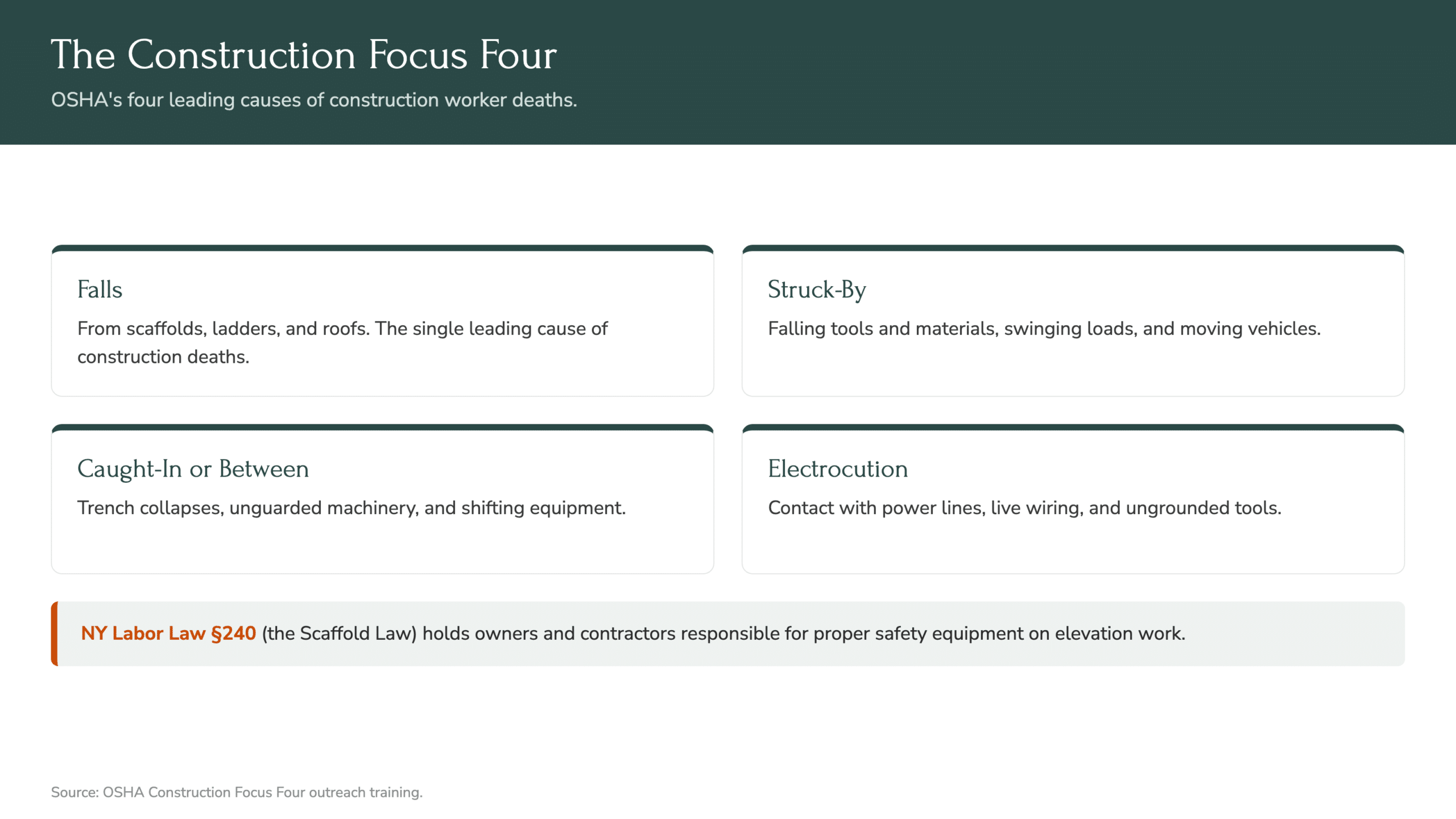
NY Labor Law §240 (Scaffold Law) requires property owners and general contractors to provide proper scaffolding, hoists, ladders, and other protective devices for workers doing elevation-related work. In plain terms, if a scaffold collapses or a ladder fails and you fall, the owner and contractor are liable even if a subcontractor or co-worker was partly responsible for the unsafe condition. This absolute liability standard is unique to New York, and it makes the state one of the most worker-protective in the country for construction injury claims.
What §240 Covers and What It Does Not
The statute covers falls from elevation and injuries caused by falling objects, but it doesn’t cover every job-site injury. Slip-and-fall injuries on the same level, equipment malfunctions unrelated to gravity, and certain types of demolition work may fall outside its reach. NY Labor Law §241 (construction safety) provides a separate, complementary set of protections, requiring contractors to keep conditions safe and comply with specific industrial code regulations throughout a project. Together, §240 and §241 form the backbone of most Brooklyn construction accident lawsuits.
Falls, Falling Objects, and Other Common Construction Injuries
The Leading Causes of Serious Injury
Falls from scaffolds, ladders, and open floors are the single largest cause of fatal construction injuries, according to BLS fatal occupational injuries by industry. Being struck by falling tools, materials, or equipment is the second most common cause of fatalities on construction sites. Electrocutions and caught-in or caught-between incidents round out the four leading hazard categories OSHA calls the Focus Four, and together they account for the majority of construction deaths each year.
Injuries Beyond Falls
Brooklyn job sites also produce serious injuries from trench collapses, crane accidents, exposure to hazardous substances, and repetitive-motion trauma. Burns, respiratory injuries from silica or asbestos exposure, and traumatic brain injuries from head strikes are all recoverable under New York law. Whether your injury fits a classic scaffold-law scenario or involves a less common cause, the first step is figuring out which legal theories apply to your specific facts.
What to Do Immediately After a Brooklyn Construction Accident
The actions you take in the hours and days after a construction injury directly affect your ability to pursue a claim. Follow these steps to protect your health and your legal rights.
- Seek medical attention right away, even if you think your injuries are minor. Documentation of your condition at or near the time of the accident is critical evidence.
- Report the accident to your supervisor or the general contractor’s safety officer before you leave the site. Ask for a written incident report and keep a copy for yourself.
- Photograph or video the hazardous condition, your injuries, and the surrounding area before anything gets moved or repaired.
- Collect the names and contact information of any witnesses, including coworkers, subcontractor employees, or passersby who saw what happened.
- File a claim with the NY State Workers’ Compensation Board promptly. New York requires injured workers to notify their employer within thirty days and to file a claim within two years.
- Preserve all physical evidence, including damaged equipment, torn clothing, or broken ladder components. Don’t let your employer or contractor throw away anything connected to the accident.
- Talk to a Brooklyn PI lawyer before giving a recorded statement to any insurance adjuster. Statements made without legal guidance can be used to shrink or deny your claim.
Workers’ Compensation vs. Third-Party Lawsuits
What Workers’ Comp Covers
Workers’ compensation provides medical benefits and partial wage replacement regardless of fault, and it’s usually the first source of recovery for an injured Brooklyn construction worker. You don’t need to prove your employer was negligent. That said, workers’ comp doesn’t cover pain and suffering, full lost wages, or long-term disability at your actual wage rate. It’s a floor, not a ceiling.
When a Third-Party Lawsuit Makes Sense
If your injury was caused or made worse by someone other than your direct employer, like a property owner, general contractor, equipment manufacturer, or another subcontractor, you may be able to bring a separate third-party lawsuit alongside your workers’ comp claim. New York Labor Law §240 and §241 are typically asserted in these third-party actions, and they allow recovery for pain and suffering, full lost earning capacity, future medical costs, and other damages that workers’ comp simply doesn’t reach. Our team regularly pursues both tracks at once to maximize the total recovery available to injured Brooklyn workers.
Contact O’Connor Injury Law for Brooklyn Construction Accident Help
A serious construction injury changes everything, and the legal landscape in Brooklyn is complicated enough that you shouldn’t try to navigate it alone. O’Connor Injury Law has experience handling scaffold-law claims, third-party construction lawsuits, and workers’ compensation matters for injured workers across all of Brooklyn’s active construction corridors, from Williamsburg to Sunset Park.
Our team will review your case, explain your options in plain English, and pursue every available avenue of recovery on your behalf. To speak with a Brooklyn construction accident lawyer about your situation, call our Brooklyn office at +1-718-878-4220. You can also visit our NYC construction accident injury book for a free guide to understanding your rights after a job-site injury.
FAQs