 Skip to Content

How Do I File a Personal Injury Claim in Staten Island, NY?

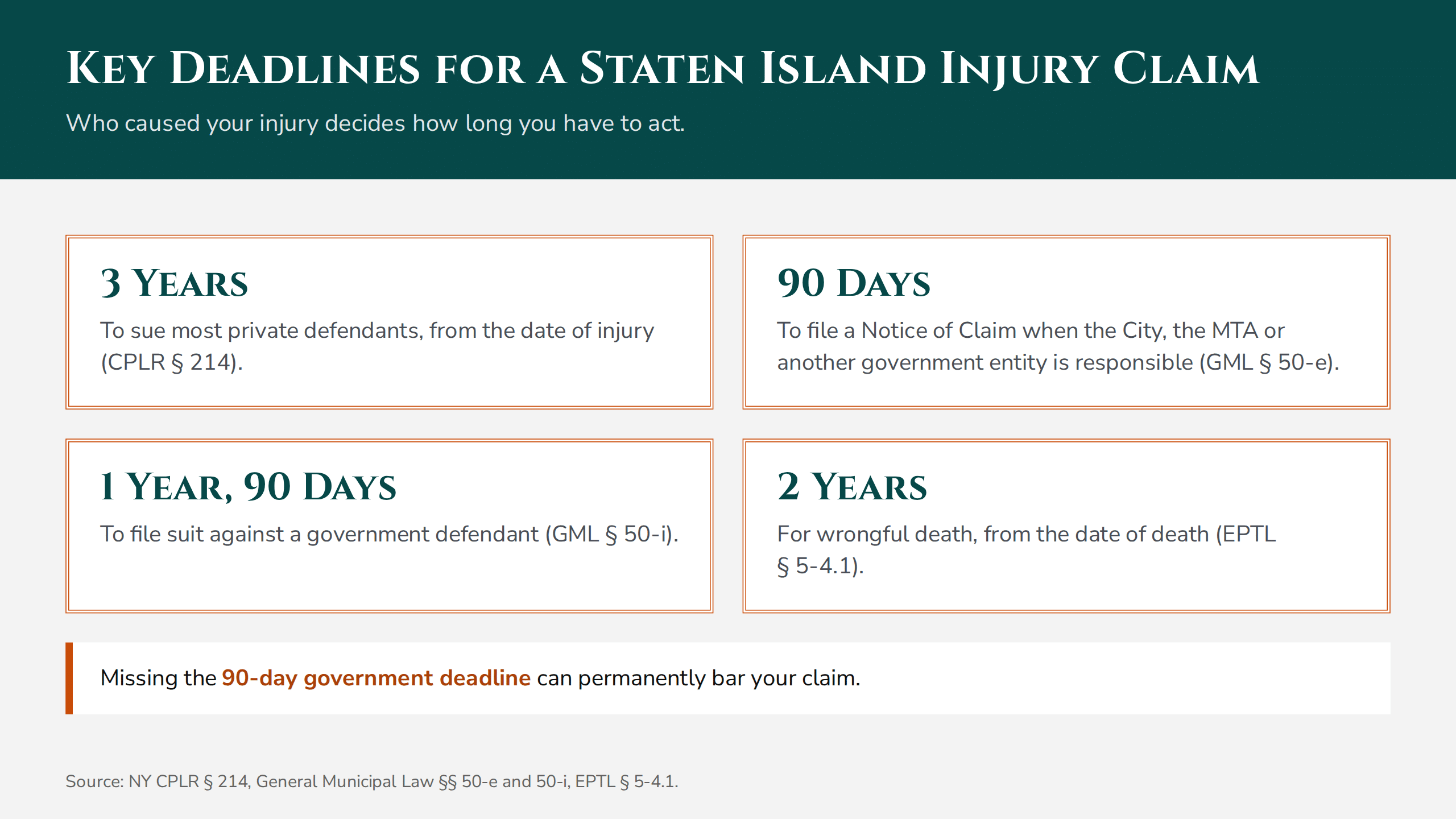
To file a personal injury claim in Staten Island, follow these steps: seek immediate medical care and preserve all records; document the scene with photos, witness information, and a police report; consult a personal injury attorney before giving any recorded statements; and file within the correct deadline. For most private defendants, New York’s statute of limitations is three years under CPLR § 214. If the City of New York, MTA, or another government entity is responsible, you must file a Notice of Claim within 90 days under General Municipal Law § 50-e. Missing that 90-day government deadline can permanently bar your claim, with no second chance.
Staten Island personal injury cases are not the same as a generic New York claim. Richmond County has its own court, its own high-crash corridors, and its own procedural traps. The sections below walk through every step, deadline, and piece of evidence you need.
What Are the Step-by-Step Rules for Filing a Personal Injury Claim in Staten Island?
Knowing how to file a personal injury claim in Staten Island means following a clear sequence of actions, starting on the day of the incident.
- Get medical attention immediately. Go to Staten Island University Hospital (North or South campus) or Richmond University Medical Center the same day if possible. Gaps in treatment become defense arguments that your injuries were not serious.
- Document the scene. Take photos and video of conditions, visible injuries, and property damage. Collect witness names and phone numbers. If law enforcement responds, get the NYPD precinct report (the four Staten Island commands are the 120th, 121st, 122nd, and 123rd Precincts).
- Preserve all evidence. Keep damaged clothing and personal property. Save every medical bill, prescription receipt, and out-of-pocket expense. Do not post anything about the incident on social media, even a vague reference, because insurers and defense lawyers monitor public accounts.
- Consult an attorney before speaking to any insurer. Even your own carrier can use a recorded statement against you. A Staten Island personal injury attorney will protect your account of events before it is locked in.
- File within the correct deadline. Private defendants: three years from the date of injury under CPLR § 214. Government defendants: Notice of Claim within 90 days under GML § 50-e, then suit within one year and 90 days under GML § 50-i. Wrongful death: two years from the date of death under EPTL § 5-4.1.
Which Staten Island Crash Locations Can Affect Your Claim?
Where your accident happened is not just a detail; it directly determines who you sue and what procedures apply.
- Richmond Avenue corridor: Identified as a high-injury corridor in the NYC DOT Vision Zero Staten Island safety data, with a pattern of pedestrian and bicycle conflicts along its length.
- Hylan Boulevard at New Dorp Lane and Tysens Lane: A corridor with a mix of rear-end and angle collisions.
- Victory Boulevard near Forest Avenue: A documented pedestrian and bicycle conflict zone flagged in the Vision Zero Borough Pedestrian Safety Action Plans.
- Staten Island Expressway (I-278): Commercial vehicle crashes here may trigger federal trucking regulations and NHTSA data, adding layers of complexity well beyond standard state tort law.
Crash location also determines your legal theory. A defective traffic signal may mean the City is liable, while a pothole claim requires proving the City had prior written notice of that specific defect under NYC Admin Code § 7-201(c)(2). Sidewalk liability frequently shifts to the abutting property owner under § 7-210. Getting the defendant wrong can cost you the case.
How Much Is a Personal Injury Case Worth in Staten Island?
There is no fixed value for a Staten Island personal injury case, but the components that drive recovery are well established.
Economic damages
These are your fully documentable losses: past and future medical bills, lost wages, and the cost of ongoing rehabilitation. Every invoice, every pay stub, and every treatment record goes into this calculation.
Non-economic damages
Pain and suffering, loss of enjoyment of life, and similar non-economic losses are available only when your injuries meet New York’s serious injury threshold under Insurance Law § 5102(d). Qualifying categories include: death, dismemberment, significant disfigurement, a fracture, loss of a fetus, permanent loss of use of a body organ or function, permanent consequential limitation of use, or significant limitation of use of a body function or system.
One important update: the 90/180-day serious injury category was repealed under Part EE of the FY2027 New York State budget (S.9008-C). If you read competitor pages that still cite that category as a qualifying threshold, that information is no longer current law.
Comparative fault and government defendants
Under CPLR § 1411, your damages are reduced by your percentage of fault. In auto cases under CPLR § 1411(b), a plaintiff more than 50 percent at fault is barred from recovering non-economic damages. Cases involving NYC municipal negligence claims carry additional complexity because the City’s defense strategy is shaped by internal priorities that are not visible from outside the Law Department.
When Is the Deadline to File a Personal Injury Claim in Staten Island, and What Happens If You Miss It?
Deadlines in Staten Island personal injury cases vary significantly depending on who caused your injury.
- Private defendants: Three years from the date of injury under CPLR § 214.
- Wrongful death: Two years from the date of death under EPTL § 5-4.1.
- City of New York, NYC agencies, NYPD, FDNY, DSNY, NYC DOE: Notice of Claim within 90 days under GML § 50-e; suit within one year and 90 days under GML § 50-i.
- MTA and NYCTA (subway and bus): A separate Notice of Claim within 90 days under Public Authorities Law § 1212.
- NYC DOE school injuries: Education Law § 3813 governs; the notice requirements differ from the GML framework and may not be tolled for infants in the same way. Confirm with an attorney immediately.
- Pothole and sidewalk defects: The City faces no liability unless it had prior written notice of that specific defect under NYC Admin Code § 7-201(c)(2), plus a 15-day cure window.
- GML § 50-h examination: Before suit can proceed against a government defendant, the City may demand a sworn pre-suit examination. This step has no equivalent in private litigation and must be completed within the statutory timeline.
If you are uncertain whether a government entity may be involved, treat the 90-day deadline as operative and consult an attorney right away. Understand what is a Notice of Claim and how it applies to your situation before that window closes.
What Evidence Do You Need to Support a Staten Island Personal Injury Claim?
Strong evidence is what separates a settled claim from a dismissed one. Build your file from day one.
- Medical records and bills: The evidentiary spine of every damages calculation. Every diagnosis, every treatment note, and every bill must be preserved in full.
- Police report or incident report: NYPD reports and NYC Parks incident reports are public records and directly support Notice of Claim filings.
- Photos and video: Scene conditions at the time of the incident, visible injuries, property damage, and surveillance footage. Request footage preservation immediately, because many commercial systems overwrite recordings within days.
- Witness statements: Names, phone numbers, and signed statements taken as close in time to the incident as possible.
- Expert witnesses: Accident reconstruction experts, medical experts, and vocational rehabilitation experts may be retained to establish causation and quantify damages.
- Prior written notice records: For City sidewalk or pothole claims, a FOIL request to the relevant agency documents what the City knew and when, which is essential for slip, trip, and fall and sidewalk accident claims.
Why Does Having a Former Assistant Corporation Counsel Matter for Your Staten Island Injury Claim?
Brian O’Connor served as a Former Assistant Corporation Counsel for the City of New York, working inside the office that defends the City against personal injury claims. That vantage point translates directly into advantages for his clients.
He knows which Notice of Claim defects the City’s lawyers exploit to get cases dismissed before trial. He understands how the NYC Comptroller’s office evaluates claims at the pre-litigation hearing stage and what settlement leverage looks like from the defense side of the table.
Cases against the City, MTA, NYCTA, or NYC DOE are filed in Richmond County Supreme Court at 26 Central Avenue, Staten Island, or in the appropriate venue based on the defendants and claim type. Local court practice in Richmond County is part of effective case preparation.
Schedule a Consultation at O’Connor Injury Law in Staten Island
If you or a family member were injured in an accident on Staten Island, the steps you take in the first days matter. Deadlines can run as short as 90 days, evidence disappears quickly, and a single recorded statement can damage a strong claim. O’Connor Injury Law serves injured New Yorkers across all five boroughs, with deep knowledge of Richmond County courts and the City’s litigation strategy from the inside. Call O’Connor Injury Law today before critical deadlines pass.