 Skip to Content

Injured by an Amazon or Delivery Truck in Manhattan? Which Lawyer Should You Call?
If you were injured by an Amazon or other delivery truck in Manhattan, you should contact O’Connor Injury Law. As a Manhattan delivery truck accident lawyer, Brian O’Connor handles commercial vehicle claims across all five boroughs from his Manhattan and Brooklyn offices. Under CPLR § 214, you generally have three years from the date of the crash to file a personal injury lawsuit against a private delivery company, but telematics data, witness accounts, and onboard camera footage disappear fast. Brian O’Connor is a Former Assistant Corporation Counsel for the City of New York, which means he knows exactly how large corporate and municipal defendants build their defenses against injured New Yorkers.
Delivery truck crashes in Manhattan are not like ordinary fender-benders. The legal landscape is far more complicated, the defendants are better-funded, and the evidence window closes faster. Here is what you need to know.
Why Are Manhattan Delivery Truck Accidents Different From a Standard Car Crash?
Most New Yorkers assume a delivery truck crash works the same way as a two-car collision. It does not. Commercial delivery vehicles operate inside a dense web of federal regulations, corporate liability structures, and multi-policy insurance programs that private drivers never touch.
- FMCSA regulations apply: Commercial vehicles like Amazon vans, FedEx trucks, and UPS step-vans are governed by Federal Motor Carrier Safety Administration regulations, including hours-of-service rules, vehicle inspection requirements, and driver qualification standards. None of those rules apply to private motorists.
- Amazon’s DSP model fragments liability: Amazon routes last-mile delivery through independently owned Delivery Service Partner (DSP) companies. That third-party contractor layer makes it harder to identify who is legally responsible for a crash.
- Multiple insurance policies are in play: The driver’s personal policy, the DSP’s commercial auto policy, and Amazon’s commercial umbrella policy may each apply, and each carrier will try to minimize its share of the loss.
- Electronic evidence must be preserved fast: Commercial fleets carry black-box telematics, GPS route data, and in-cab cameras. That data can be overwritten on the carrier’s own retention schedule unless a litigation hold letter is sent immediately.
- New York’s comparative fault rule matters: Under CPLR § 1411, New York follows pure comparative negligence: being partly at fault reduces your recovery in proportion to your share of the fault, but it does not bar you from recovering. That makes a thorough liability investigation critical from the very first day.
Where in Manhattan Do Delivery Truck Accidents Happen Most Often?
Manhattan absorbs a dense, continuous flow of commercial vehicle traffic through narrow streets and constant loading-zone turnover. That volume creates predictable collision hot spots that a knowledgeable attorney can investigate with precision.
NYC DOT Vision Zero High Injury Network data maps the streets and intersections where the most serious crashes cluster citywide. In Manhattan the risk concentrates where dense freight activity meets heavy pedestrian and cyclist traffic: the avenue corridors that carry commercial vehicles through Midtown, the loading-zone streets near the bridge and tunnel approaches, and the lower Manhattan blocks where last-mile vans double-park. Checking the current Vision Zero map for the specific location of your crash is part of the investigation.
Knowing where crashes cluster helps an attorney reconstruct the scene, identify city infrastructure defects, and locate surveillance camera footage before it is erased.
Who Is Liable When an Amazon Delivery Driver Hits You in Manhattan?
Liability in a Manhattan delivery truck accident claim almost never falls on a single party. Your attorney needs to investigate every possible defendant from day one.
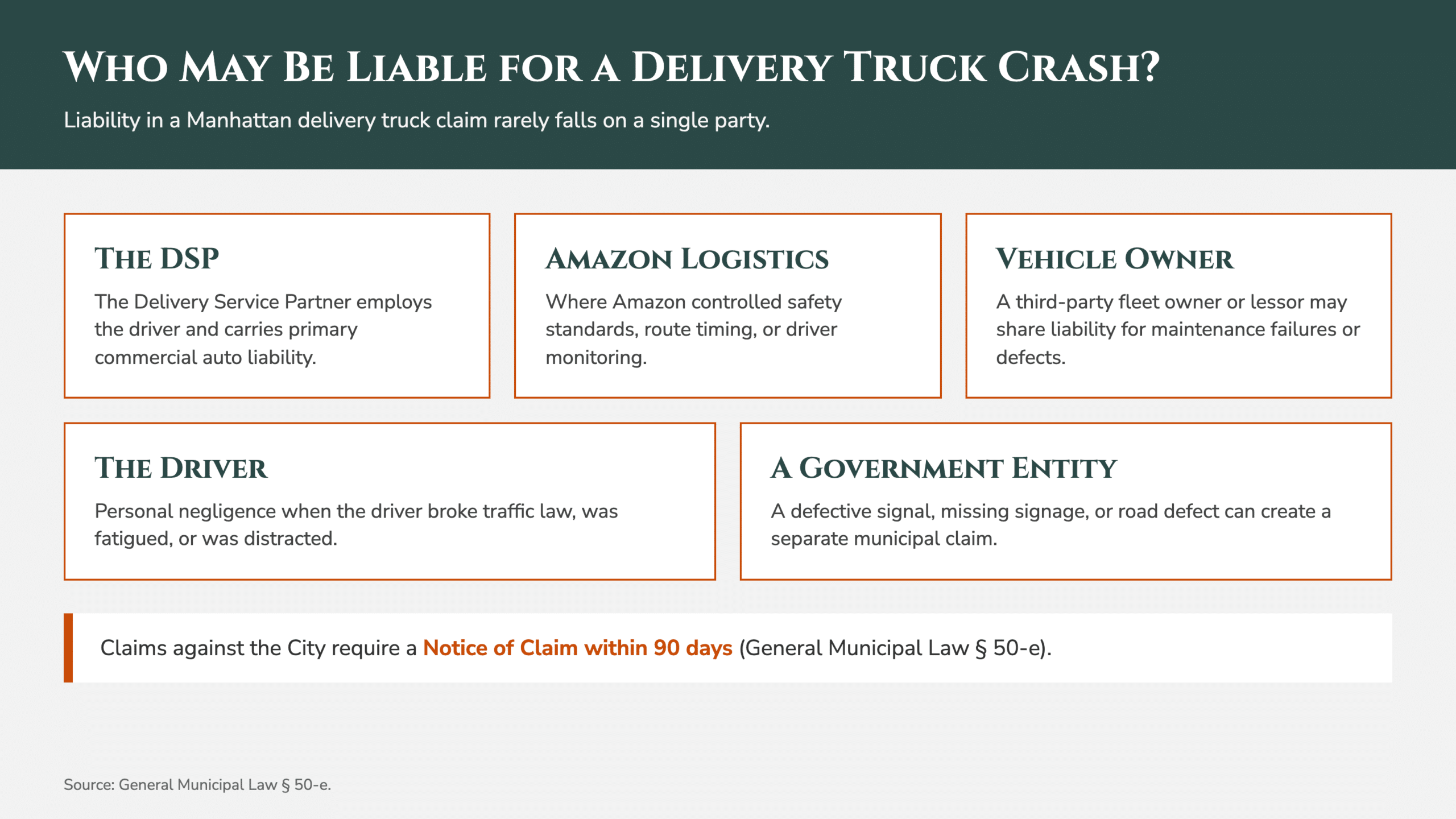
- The DSP: Amazon’s Delivery Service Partner employs the driver and carries primary commercial auto liability. In most claims, the DSP is the first named defendant.
- Amazon Logistics itself: Where evidence shows Amazon controlled safety standards, route timing, or driver performance monitoring, courts in New York have allowed direct negligence claims against Amazon under a retained-control theory.
- The vehicle owner: If the van is leased or owned by a third-party fleet company, that entity may share liability for maintenance failures or defective equipment.
- The driver individually: Personal negligence claims run alongside employer liability when the driver violated traffic law, was fatigued, or was distracted.
- A government entity: If a defective traffic signal, missing signage, or a road defect contributed to the crash, a separate municipal claim may arise. When the City of New York is involved, a Notice of Claim must be filed within 90 days under General Municipal Law § 50-e. Missing that window typically bars the municipal portion of your claim entirely. Learn more about what is a Notice of Claim and when do you need one.
What Does Brian O’Connor’s Insider Knowledge Mean for Your Manhattan Truck Accident Claim?
Most personal injury attorneys know how to pursue a claim. Brian O’Connor also knows how to defend one, and that distinction matters enormously in high-stakes commercial vehicle cases.
As a Former Assistant Corporation Counsel for the City of New York, Brian O’Connor spent years defending the City against personal injury lawsuits. He watched how government defendants and large institutional insurers structure their investigations, build comparative-fault arguments, and delay proceedings to pressure injured plaintiffs into low settlements. That experience is now working for you, not against you.
That background is especially valuable when a City vehicle, such as a sanitation truck, a DOT fleet vehicle, or a Parks Department van, is involved in a Manhattan delivery-zone collision. Cases involving NYC municipal negligence and City vehicle accidents carry procedural requirements that most plaintiffs’ attorneys rarely encounter. O’Connor Injury Law handles them routinely. The firm’s offices in Manhattan and Brooklyn allow for prompt on-the-ground investigation and in-person client meetings across the borough.
What Injuries and Damages Can You Recover After a Manhattan Delivery Truck Accident?
Delivery trucks outweigh passenger vehicles by thousands of pounds. When they strike a pedestrian, cyclist, or smaller vehicle, the injuries are often severe.
Common catastrophic injuries in these crashes:
- Traumatic brain injury
- Spinal cord injury and paralysis
- Limb fractures requiring surgery
- Internal organ damage
- Complex regional pain syndrome
Recoverable damages fall into two categories:
- Economic damages: Past and future medical expenses, lost wages, diminished earning capacity, and property damage.
- Non-economic damages: Pain and suffering, loss of enjoyment of life, and permanent disability. To recover non-economic damages, New York’s serious injury threshold under Insurance Law § 5102(d) requires proof of a qualifying injury, such as a fracture, significant disfigurement, permanent loss of use, or significant limitation of a body function or system.
Punitive damages may be available when a DSP or Amazon knowingly violated FMCSA hours-of-service rules or concealed prior safety violations. New York’s no-fault system provides initial coverage for medical bills and a portion of lost wages regardless of fault, but serious injury claims step outside no-fault and are pursued directly against the at-fault party. For catastrophic injury representation in New York City, O’Connor Injury Law evaluates the full scope of damages from day one.
What Should You Do Immediately After Being Hit by a Delivery Truck in Manhattan?
The steps you take in the hours and days after a crash can make or break your recovery. Follow this sequence carefully.
- Call 911 and get a police report. The MV-104 accident report is foundational evidence in every New York personal injury claim.
- Photograph everything at the scene. Capture the vehicle’s DOT number, license plate, Amazon or DSP branding, and any route paperwork visible in the cab window.
- Collect witness information. Get names and contact details from bystanders immediately. Manhattan sidewalk witnesses tend to leave scenes quickly.
- Seek emergency care right away. Bellevue Hospital Center, NewYork-Presbyterian/Weill Cornell, and Mount Sinai are major Level I trauma centers accessible from Midtown and Lower Manhattan. Even if you feel okay, get evaluated.
- Do not give a recorded statement. Any insurer, whether the DSP’s or Amazon’s, will use your words to minimize your claim. Speak to a lawyer first.
- Contact a Manhattan delivery truck accident lawyer promptly. A litigation hold notice must be sent quickly to preserve telematics, GPS route data, and in-cab camera footage before it is overwritten.
Time is the one resource you cannot recover. For a full overview of motor vehicle and truck accident claims in New York, visit the firm’s practice page.
Contact O’Connor Injury Law for a Free Consultation in Manhattan
If an Amazon van, FedEx truck, or any commercial delivery vehicle injured you in Manhattan, you deserve an attorney who understands exactly how these cases are built and how the other side fights them. O’Connor Injury Law brings a unique combination of plaintiff advocacy and insider knowledge of City and corporate defense tactics to every claim. The firm serves injured New Yorkers across all five boroughs from offices in Manhattan and Brooklyn. Call O’Connor Injury Law today for a free consultation and let Brian O’Connor put his experience to work for you.