 Skip to Content

Who Is Responsible for Sidewalk Repair in New York City?
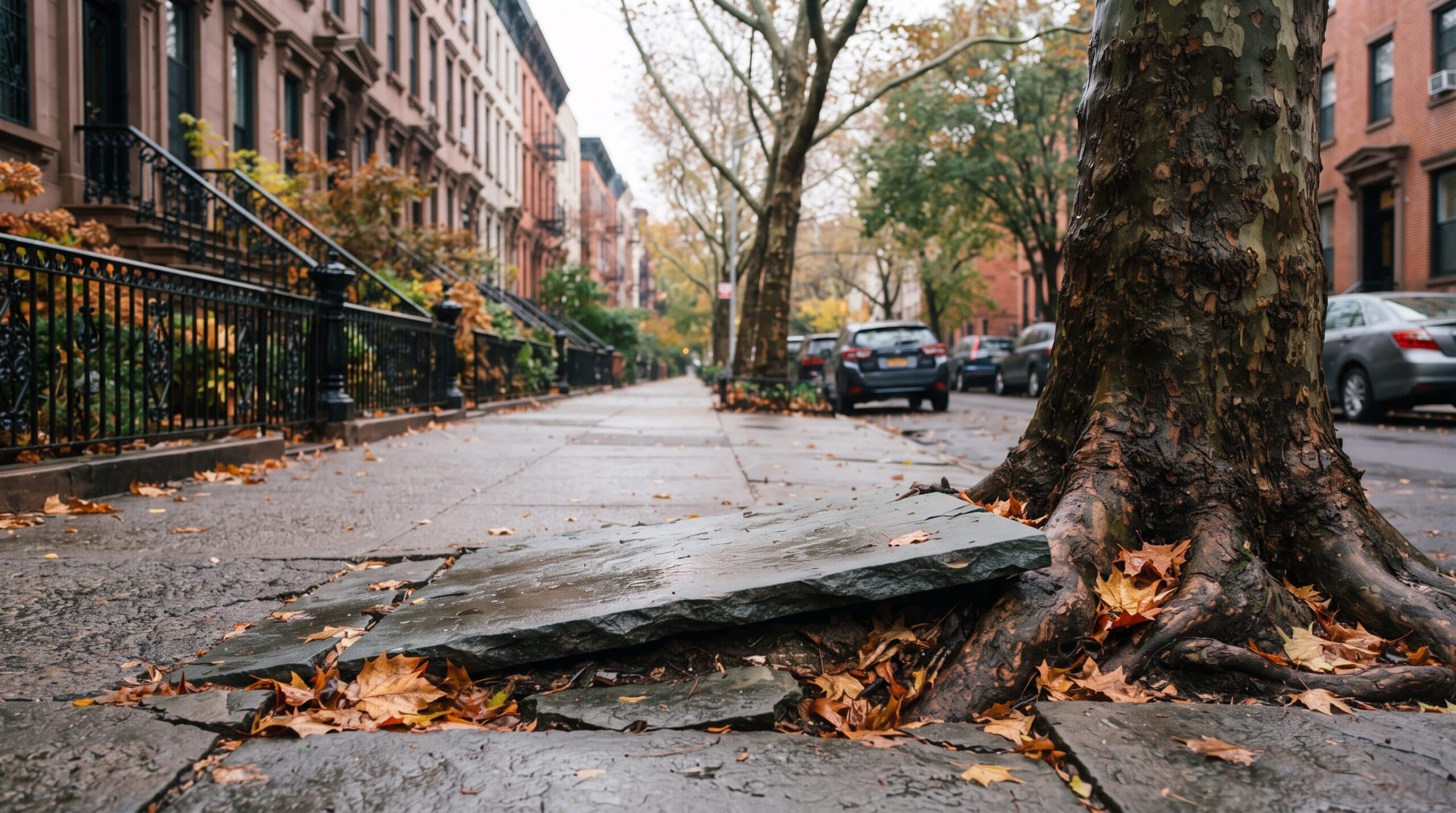
Who is responsible for sidewalk repair in NYC? Under NYC Administrative Code § 7-210, adjacent property owners, not the City, are legally required to maintain and repair the public sidewalk in front of their building. If a cracked flag, raised slab, or uncleared ice patch causes you to fall, the abutting property owner is typically the liable party. One critical exception applies to owner-occupied one-, two-, and three-family residential buildings used solely for residential purposes, where liability for typical defects shifts back to the City of New York.
New York City sidewalks carry constant pedestrian traffic, and NYC sidewalk slip and fall cases are among the most fact-intensive personal injury matters an attorney handles. The liability analysis turns not on where you fell, but on who owns the building next to where you fell, and what that building is used for. Getting that answer right, early, shapes every decision that follows.
Who Owns the Sidewalk in NYC, and Why Does the Distinction Matter?
The City of New York holds title to the public right-of-way, including the land beneath every sidewalk in all five boroughs. That legal ownership does not mean the City is responsible when a pedestrian trips on a broken slab.
Ownership vs. Liability: Two Separate Legal Questions
The NYC Department of Transportation regulates the public right-of-way, issues violation notices to property owners whose sidewalks are out of compliance, and can step in to make repairs when an owner fails to act. But DOT ownership and DOT liability are not the same thing.
NYC Administrative Code § 7-210, enacted in 2003, transferred the legal duty to maintain and repair sidewalks from the City to the owner of the abutting property. When you sue after a fall, you are almost always suing the property owner next to the defect, not the municipal government.
What Does NYC Administrative Code § 7-210 Actually Require?
Section 7-210 is the statute at the center of nearly every premises liability in New York City sidewalk case. It places a clear, non-delegable maintenance and repair obligation on the abutting property owner.
Covered Duties Under § 7-210
Property owners subject to the statute must:
- Fix structural defects: cracked flags, raised or sunken slabs, and uneven pavement that create trip hazards.
- Remove snow and ice: clear accumulations within a reasonable time after precipitation ends.
- Clear debris: keep the sidewalk free of obstructions that could cause a fall.
The duty is non-delegable. A landlord cannot transfer legal exposure to a commercial tenant through a lease provision. If the lease says the tenant handles sidewalk maintenance and the tenant fails to act, the property owner still faces liability to an injured pedestrian.
Violation Notices and the Repair Timeline
When DOT inspects a sidewalk and finds a defect, it issues a violation notice to the property owner. NYC sidewalk inspection and repair standards under § 19-152 require that repairs be made by licensed contractors following specific specifications. If an owner ignores a violation, the City can perform the repair itself and bill the owner for the cost. That billing record often becomes useful evidence in personal injury litigation.
When Is the City of New York, Not the Property Owner, Liable for a Sidewalk Injury?
Several well-defined exceptions bring liability back to the City. Identifying which exception applies, if any, is one of the most important early steps in a sidewalk injury investigation.
The § 7-210(b) Residential Exception
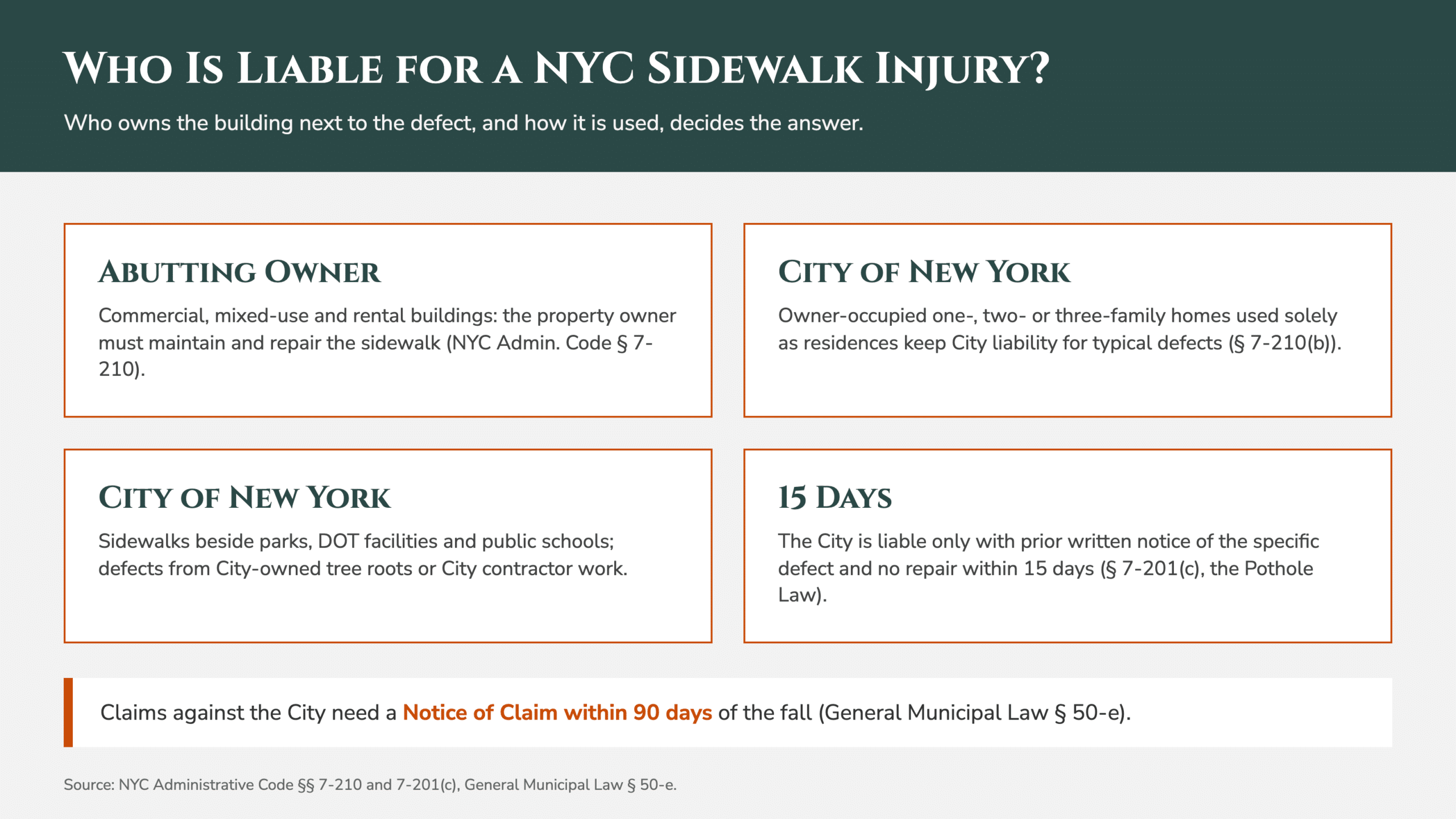
Owner-occupied one-, two-, or three-family residential properties used solely for residential purposes retain City liability for typical sidewalk defects under § 7-210(b). If the owner rents out the building or uses any part of it commercially, this exception disappears and liability shifts to the owner.
Other Situations Where the City Remains Liable
- City-owned property: Sidewalks abutting parks, DOT facilities, or public schools remain the City’s responsibility.
- Tree damage: When a City-owned tree’s roots crack or lift a sidewalk flag, the NYC Parks Department, not the abutting owner, bears responsibility.
- City contractor or utility work: Defects caused by a City contractor performing subsurface or roadway work may make the City the proper defendant.
The Pothole Law: Prior Written Notice Requirement
Even when the City is the proper defendant, suing it is not straightforward. Under NYC Administrative Code § 7-201(c), commonly called the Pothole Law, the City cannot be held liable for a sidewalk defect unless it received prior written notice of that specific defect and failed to repair it within 15 days. Without documented proof of prior notice, a claim against the City will almost always be dismissed at the summary judgment stage.
Reporting a defect to 311 creates an official written record that can satisfy the prior-written-notice requirement for future claimants and starts the 15-day repair clock.
What Is the 90-Day Notice of Claim Deadline, and Why Does It Apply to Sidewalk Cases?
When the City or a City agency is a potential defendant in a sidewalk case, a strict procedural clock begins running from the moment of the injury.
General Municipal Law § 50-e and the 90-Day Window
Under General Municipal Law § 50-e, any claim against a New York City agency must be preceded by a Notice of Claim filed within 90 days of the incident. Missing this deadline generally bars the claim against the City entirely, with very limited exceptions granted by court order. Understanding what is a Notice of Claim and how does it work is essential before any contact with City representatives or their insurers.
The GML § 50-h Examination
After receiving a Notice of Claim, the City can compel the injured person to testify under oath in a sworn pre-suit examination before any lawsuit is filed. This proceeding, called a GML § 50-h examination, has no equivalent in private-property cases. What you say at that hearing can significantly affect the outcome. The statute of limitations for suits against the City is one year and 90 days from the date of the incident under GML § 50-i. No comparable short deadline applies to a private property owner, but delay still erodes evidence.
How Does Brian O’Connor’s Inside Knowledge of the City’s Defense Playbook Help Sidewalk Injury Victims?
Brian O’Connor is a Former Assistant Corporation Counsel for the City of New York, where he defended the City in personal injury cases including sidewalk and premises liability claims. That experience means he has sat across the table from injured plaintiffs in exactly the situations his clients now face.
Knowing the Defense Before It Arrives
He knows which arguments the City’s legal team deploys first: the prior-written-notice defense under § 7-201(c), the § 7-210 liability-shifting analysis, and contributory fault arguments aimed at the injured pedestrian. That insider knowledge shapes how he builds a sidewalk injury file from day one, before the City’s attorneys even receive the Notice of Claim.
The Notice of Claim content and the GML § 50-h testimony are the two moments that most often determine the outcome of a City sidewalk case. Errors at either stage are difficult or impossible to correct later. Having an attorney who has handled these examinations from the City’s side, and now handles them exclusively for injured New Yorkers, is a concrete tactical advantage.
For claims against private property owners, the same meticulous approach applies: securing photographs, identifying the abutting owner, tracing DOT violation records, and building the liability file before the property owner’s insurance company closes ranks. These matters fall squarely within NYC municipal negligence claims and broader premises liability practice.
What Should You Do After a Sidewalk Trip or Slip and Fall in New York City?
The steps you take in the hours and days after a sidewalk injury directly affect the strength of your claim.
- Document the defect immediately: Photograph the cracked flag or raised slab, note the exact address, and measure the height differential if you are able.
- Identify the abutting property: Note whether it is residential, commercial, or City-owned, and whether the building appears to be owner-occupied.
- Report to 311: Filing a 311 complaint creates an official written record of the defect, which can support the prior-written-notice requirement under § 7-201(c).
- Seek medical evaluation promptly: Gaps in treatment become defense arguments. A same-day or next-day evaluation ties your injuries to the incident.
- Contact a personal injury attorney before speaking with any insurance adjuster: Statements made to a property owner’s insurer can be used to minimize or deny your claim.
O’Connor Injury Law handles sidewalk injury cases across all five boroughs, including Staten Island, Brooklyn, Manhattan, Queens, and the Bronx, from offices in Staten Island, Brooklyn, and Manhattan.
Contact O’Connor Injury Law After a Sidewalk Injury in New York City
Sidewalk injury cases in New York City involve overlapping statutes, tight procedural deadlines, and defendants ranging from private landlords to City agencies. O’Connor Injury Law, based in Staten Island with offices in Brooklyn and Manhattan, brings firsthand knowledge of how the City defends these cases. If you or a family member was hurt on a defective sidewalk anywhere in the five boroughs, call O’Connor Injury Law today for a free consultation.